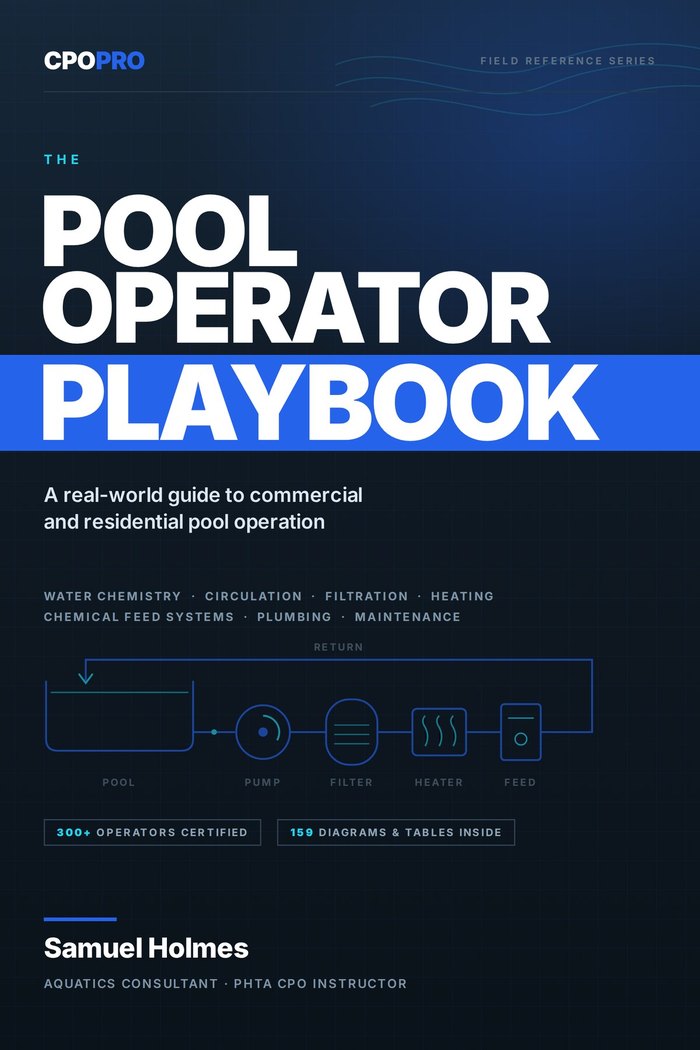
This is the
cheat code.
I always stress to my students the importance of real-world learning, the kind that comes from troubleshooting and using the fundamentals in the field. Getting certified as a CPO matters, but that course is written for regulators as much as it is for operators. Nobody takes an online course and becomes a pool operator in a day. Learning to be the expert comes with time and experience.
Until now, there wasn’t much out there giving an operator an edge in the field. This is that edge. This is the book I wish had been sitting in the seat next to me in my little Ford Ranger that first year I started working on swimming pools. It is the real-world guide that will help you be the expert you need to be, even when you don’t have all the experience to back it up yet.
Built for commercial and residential operators alike, it is what you take with you to make sense of what the job puts in front of you. This is the playbook you need, and the one I wish I’d had when I started out.
Written by Samuel Holmes, PHTA Certified CPO Instructor. 14 years in the trade, two pool companies built and sold, 300+ operators certified.
Two ways to own it.
The digital edition comes straight from me and lands in your inbox in about a minute. The paperback comes from Amazon and takes a couple of days.
- EPUB for iPhone, Android, Kindle, Apple Books and Kobo, reflowing to whatever text size your eyes want
- The complete 350-page full-color PDF, the same file the paperback is printed from
- Searchable in a pump room, on the phone already in your pocket
- All 91 diagrams and 68 reference tables, in color
- Free updates for the life of this edition, emailed to you
- Yours to keep, on as many of your own devices as you like
- Printed in full color throughout
- High-quality paperback, 6×9 in, 350 pages
- Ships from Amazon, Prime eligible for quick shipping
Enrolling in a CPO class? The digital edition is included free with your seat. Just pick a test date, nothing to tick.
Chapter 9, on cyanuric acid.
The longest chapter in the book and the one operators argue about most. It is the whole chapter, eleven pages, free, and it will tell you inside two minutes whether the rest of the book is written for you. No email required.
What the classroom leaves out.
A CPO course certifies you. Nobody walks out of two days in a classroom knowing what a loaded sand filter sounds like, or why the pool in front of them is eating chlorine by two in the afternoon. This is that part.
Every number is worked
One master dosing formula, then a dose library built on it, each one carried through on a real pool volume. Not a formula printed once and left for you to apply.
159 diagrams and tables
Ninety-one figures and sixty-eight reference tables, drawn for this book, in color. Saturation index factor tables, dose tables by product, and a complete cheat sheet you can print for the pump room door.
Positions the industry argues with
Filter sand does not need replacing. Rain does not crash your pH. A bigger pump is usually the wrong answer. Each one comes from time on the job, with the reasoning next to it.
Commercial and residential, side by side
The chemistry is the same; the code you answer to is not. The book runs both, and it marks where the rules bend on a backyard pool and where they do not bend at all.
A full diagnostics section
Part Eight is the diagnostic method, then water, chemistry and equipment problems, then weather and seasonal events. It is written to be opened at the equipment pad.
Blank forms you may copy
Appendix E is daily logs, weekly records, incident reports and inspection checklists, and the copyright page explicitly permits a purchaser to print them for their own facility. Free full-size versions live on the Resources page.
Don't guess! Test!
Fifty-two chapters, eight parts.
Parts One through Five are the foundation every operator needs. Part Six is the commercial facility. Part Seven is the residential pool. Part Eight is what you open when something is wrong.
The Operator's Foundation
What the job involves, what has to be written down, and how to measure any body of water.
Water Chemistry
Eight readings, the order they get corrected in, and every dose worked out from one number.
Circulation, Filtration & the Pump Room
Water in, water out. Hydraulics without the headache, pump curves, turnover math, and entrapment.
Plumbing & Chemical Feed
Pipe sizing and velocity, valves, feeders, controllers, and the installation mistakes that cost thousands.
Heating Systems
BTU sizing, heat loss, what a correct gas installation looks like, and when to stop and call a licensed pro.
The Commercial Facility
Written against the model code and the CDC's own inspection data. Bather load, testing, inspections, contamination response, and when to close.
The Residential Pool
Where the rules bend, which is most of them. Saltwater in the real world, surfaces, cleaners, algae, and working with homeowners.
Diagnostics
The part you open standing at an equipment pad with something wrong in front of you.
A The Complete Cheat Sheet · B Dose Tables by Product · C Saturation Index Factor Tables · D Conversions & Constants · E Blank Forms and Logs · F Resources, Codes & Where to Get Certified
Every table in the back prints full size, free, from the Resources page, for the pump room door. The printed index is in the paperback and the PDF; the EPUB uses your reader's own search instead, which is better.
Samuel Holmes

Four months into an IBEW electrical apprenticeship in San Antonio, Samuel worked out he could not do it. A friend introduced him to the idea of being a pool guy. He got CPO certified before he had a single customer or a truck to put anything in.
Two pool service companies built and sold since, most recently The Aqua Academy in Bend, Oregon. PHTA Certified CPO Instructor since 2017, more than 300 operators certified. Still on pool decks every week.
Read the full bio →This book is not affiliated with, endorsed by, or approved by the Pool & Hot Tub Alliance, the CDC, or any health authority. It is not a substitute for the CPO course or for any certification your jurisdiction requires.
No product named in it is a paid placement. Neither Samuel nor CPO PRO has any affiliate, referral or commercial relationship with any brand named in these pages. Products are named because he uses them, or because they are the clearest example of their type.
Pool operation involves hazardous chemicals, pressurized equipment, gas-fired appliances and electrical systems. Codes vary by state and locality and change over time. Always verify against your current local health code.
Before you buy.
Three hundred and fifty pages,
in your pocket, in a minute.
EPUB and the full-color PDF, $24. Or the paperback from Amazon at $33.95.